

Your Patients Trust You.
Protect That Trust.
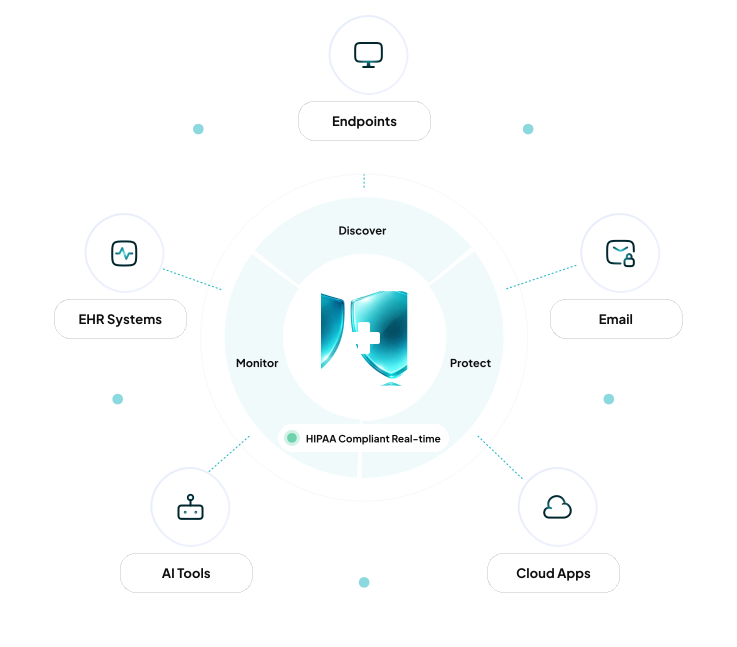
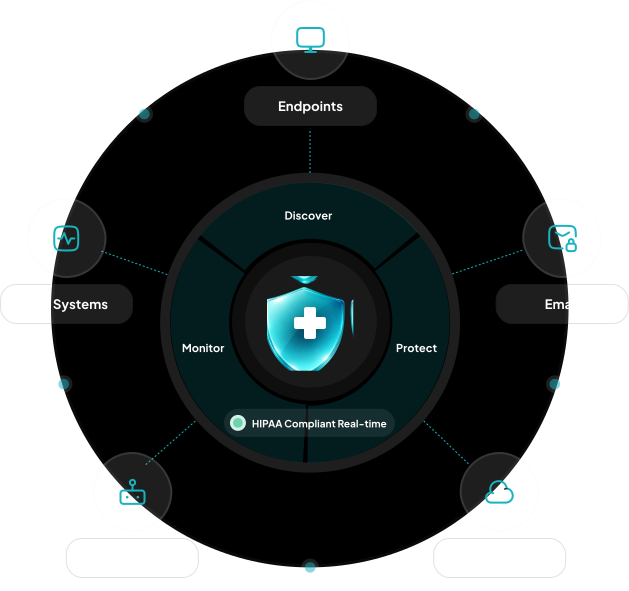
Healthcare is the most targeted industry for data breaches — and the most penalised for failing to prevent them. Defensely gives hospitals, clinics, and health networks real-time protection over every piece of PHI across endpoints, email, cloud, and AI tools. HIPAA-ready from day one.

OUR IMPACT ON HEALTHCARE


Trusted by leading healthcare companies



Needed a DLP Compliance
For NIST-CSF compliance, we tested DLP tools and found Strac the easiest to set up, with clear alerts and responsive support. We use its SaaS integrations and AI DLP to protect sensitive data across platforms like ChatGPT and Google Gemini. The dashboard is simple and effective.

Ethan
Chief Technical Officer

CHALLENGES
Healthcare Data Doesn’t Just Leak. It Gets Stolen.
The threat isn’t just ransomware from outside. Most PHI exposure happens from within — a nurse emailing patient records home, a contractor plugging in a USB, a doctor uploading files to a personal cloud. Defensely was built for all of it.
Challenge 1
Inappropriate PHI Sharing
Problem :
Clinical staff unknowingly share PHI via email, Teams, or Slack—often after it’s already exposed.
Solution :
Defensely blocks or quarantines PHI in real time with HIPAA-aligned, automated controls.
Pain point solved
Challenge 2
Insider Threats
Problem :
Insider threats cause most breaches, often discovered weeks later.
Solution :
Defensely detects anomalies in real time with behavior analytics and risk scoring.
Pain point solved
Challenge 3
Device-Based Data Leaks
Problem :
Patient data leaks via USB and personal devices, often without trace.
Solution :
Defensely blocks unapproved devices and enforces offline device-level control.
Pain point solved
Challenge 4
Audit Readiness Gaps
Problem :
Audit readiness gaps delay compliance and investigations.
Solution :
Defensely provides real-time, HIPAA-ready audit logs and instant reports.
Pain point solved


HOW DEFENSELY HELPS
Built for Healthcare
PHI Content Detection
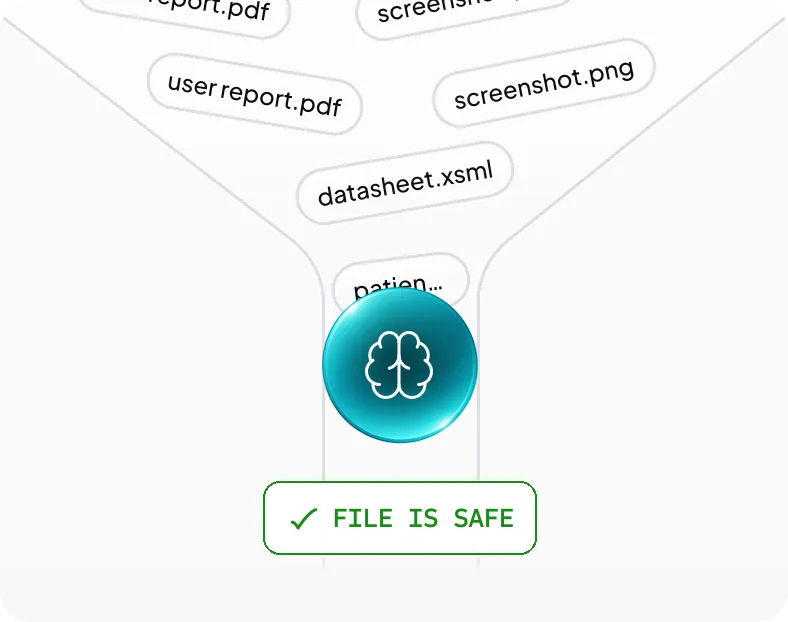
Detect and safeguard PHI wherever it exists, ensuring compliance with real-time protection.
 Identify and protect PHI across all data sources
- Monitor documents, emails, endpoints, and cloud
- Ensure HIPAA compliance with AI-driven detection
- Prevent data leaks and unauthorized access in real time
- Use strong encryption for sensitive data
AI Platform Lockdown
Stop sensitive data from leaking into AI tools with real-time monitoring and control.
- Prevent PHI sharing in AI tools
- Monitor text input and file uploads
- Control copy/paste of sensitive data
- Secure AI usage with real-time protection
- Implement user training on data privacy best practices
Remote Staff Protection
Protect data across remote devices and ensure security even on unmanaged systems.
- Lightweight agents across all major operating systems
- Real-time threat detection and response
- Stay protected even offline
- Secure personal and unmanaged devices
- User-friendly interface for easy management
CORE FEATURES
Features that power healthcare data security
Sensitive Data Detection Engine
Identifies 80+ sensitive data types using pattern matching, regex, and contextual ML — including data embedded in images via OCR.
Data Discovery & Classification
Automatically scans and classifies sensitive data at rest across file servers, databases, shared drives, and cloud storage.
Compliance Audit Reports
Generate tamper-proof audit trails on demand — who touched what, where it went, and what action was taken. Ready for any regulatory review.
User & Entity Behaviour Analytics
Baselines normal behaviour per user and device, then surfaces anomalies that signal insider threats, credential misuse, or policy evasion.
Data Leakage Prevention
Monitors 15+ exfiltration channels simultaneously — USB, cloud, browser, print, screenshot, and messaging apps — enforcing policies in real time.
Still struggling to make a decision ?
See exactly how Defensely maps to your HIPAA obligations — in a live walkthrough built around your environment, not a generic demo.
BENEFITS
Protect Your Patients. Protect Your Organisation.

Effortless Compliance
HIPAA-ready templates configure the right controls automatically. Go from installation to compliant in a day.

Protection That Follows the Data
PHI moves through email, USB, AI tools, and Slack. Defensely follows it across every channel.

Full Visibility. Zero Blind Spots
See every PHI interaction in real time — who touched it, where it went, and whether your policy stopped it.

Zero Disruption to Clinical Workflows
Runs at under 1% CPU overhead. Nurses and doctors never notice it — only violators do.

Stop AI Exposure Before It Starts
Staff are pasting patient data into ChatGPT without thinking. Defensely detects and blocks it instantly.
Effortless Compliance
HIPAA-ready templates configure the right controls automatically. Go from installation to compliant in a day.
Protection That Follows the Data
PHI moves through email, USB, AI tools, and Slack. Defensely follows it across every channel.
Full Visibility. Zero Blind Spots
See every PHI interaction in real time — who touched it, where it went, and whether your policy stopped it.
Zero Disruption to Clinical Workflows
Runs at under 1% CPU overhead. Nurses and doctors never notice it — only violators do.
Stop AI Exposure Before It Starts
Staff are pasting patient data into ChatGPT without thinking. Defensely detects and blocks it instantly.
FAQ
Frequently Asked Questions
The Health Insurance Portability and Accountability Act of 1996, commonly known as HIPAA, provides data privacy and security measures for protecting medical information in the US. The legislation is designed to safeguard individuals’ protected health information (PHI), such as Social Security Numbers, medical records, telephone numbers, etc. In 2009 the legislation was updated with HITECH (Health Information Technology for Economic and Clinical Health), bringing additional compliance standards to businesses linked to healthcare.